Length: 21 days
Tour Company: G Adventures
Tour: Inca Heartland – Lima to La Paz (Lares Trek)
Traveler: Dave
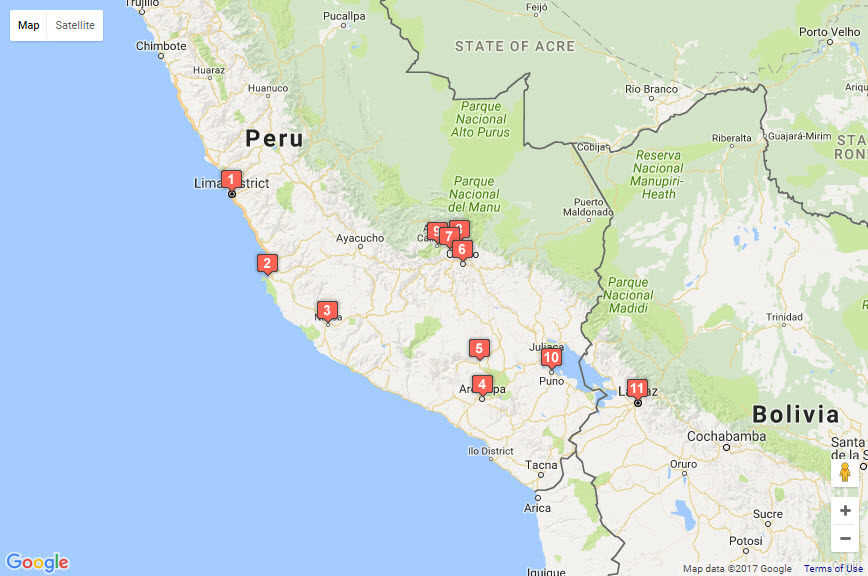
Places visited*:
- Lima, Lima
- Paracas, Ica
- Nazca, Ica
- Arequipa, Arequipa
- Colca Canyon / Chivay, Arequipa
- Cuzco, Cuzco
- Ollantaytambo, Cuzco
- Lares Trek
- Machu Picchu / Aguas Calientes, Cuzco
- Puno / Lake Titicaca, Puno
- La Paz, La Paz, Bolivia (see my Bolivia page for more)
*It’s important to include the region as the same city names are used in other regions.
Lima, Lima
Upon arrival in Lima (LIM) Jorge Chávez International Airport, close to midnight, immigration is quite easy to navigate and clear. Next stop is the baggage area which has only one option for local SIM Cards, through Claro. I opted to skip getting a SIM card through Claro and look for the Movistar kiosk, because I read that Movistar has better coverage and 4G speeds throughout Peru. I also read on a few blogs that Movistar had a kiosk at the airport, but I quickly found out that they do not. I decided to get a SIM from one of their stores in along the trip. In the end, I was greatly disappointed by Movistar. It took an hour and a half at their store to get a SIM card, which ended up not having any data or minutes on it at all. I was told I would have to go have the card Recharged at any store (Movistar or convenience) that sells recharges. I asked for Movistar recharges at many of their stores and convenience stores and no one seemed to be able to help me. Finally, after a week and a half, I was able to get a recharge from the Movistar store in Cuzco, but it cost $30 for 1 GB, and I could not get service in many locations. Based on my experience, and the SIM card the guide was using, I suggest getting a Claro SIM card at the airport to avoid any headaches.
After collecting my baggage, I was met outside the baggage area by my driver, who had a sign with my name on it, and took a private car to Casa Suyay Hotel in Miraflores. The ride took around 45 minutes with traffic.
Casa Suyay Hotel is a small boutique hotel located 50 meters from the Parque Central de Miraflores near a wide variety of stores, restaurants, and bars. There are bus stops all along the park that give you the ability to get around the city. The room I was in was located on the 3rd floor, above the lobby. Due to its location, you could easily hear anyone talking in the lobby. Lucky for me, there wasn’t many people in the lobby during the night. The beds are comfortable for the level of hotel and there is a flat screen TV with plenty of channels. The showers are hot and have good pressure. WiFi was available in the hotel with a router for each floor. I had a lot of trouble accessing the internet from the one on my floor, but the one in the lobby worked quite well.
Day 2 started with the morning to ourselves to explore and get ready for our 3 week aventure. In the afternoon, we loaded a private van for a quick 20 minute ride to the Javier Prado bus station for the 4 hour bus ride to Paracas, Ica, aboard the Cruz del Sur Ica Line Express. The terminal has restrooms and a cafeteria for use while waiting for your bus. Arrive approximately 1.5 hours before the departure time to buy your bus tickets as they can sell out fast. This bus was a really nice double-decker sleeper bus with “first class” seats downstairs and regular seats upstairs. By regular seats, I mean reclining, leather, tray in the seatback, blanket, pillow, seatbelt (required in Peru), and a TV with movies, games, music, etc., and there’s a bus attendant to serve you a meal and drink (which was better than most airline coach class food). I can’t imagine what made “first class” special, other than it is on the ground floor and less swaying on the drive. The bus has a bathroom on board, which is definitely a plus.
Paracas, Ica
We arrived in Paracas after sunset and checked into the Hostal Refugio del Pirata, a basic hostal that was good for the 1 night we stayed. My room was on the top floor, up a narrow, steep set of stairs, and adjacent to the breakfast deck. The beds were quite small (single/twin) and 2 beds took up most of the space in the room. Getting between one of the beds to the en-suite bathroom was a bit of a tight squeeze.
After checking in, we went for drinks to try the local Peruvian favorite, Pisco Sour, and then to dinner at Punto Paracas Restobar.
Let’s discuss the Pisco Sour for a second. I was not a fan and the most of the group seemed to agree that is not their favorite. One was more than enough for most everyone, but it is their national drink, so, give it a try. This drink is made of the following:
1.00 oz Lemon Juice
1.00 Egg white, raw
1.50 oz Pisco (a local brandy produced from Peruvian wine grapes)
0.75 oz Simple syrup
Vigorously shake and strain contents in a cocktail shaker with ice cubes, then pour liquid into glass and garnish with bitters. Serve straight up, without ice.

Dinner at Punto Paracas Restobar was, well, it was food. Unfortunately, quite a few of the restaurants visited on this trip were, in my opinion, disappointing. I don’t want to say all the meals were bad, but others in the group were also not happy with their meals.
Following dinner, a few of us went to a neighboring hostel (Hostal Kokopelli Paracas) to drink at their bar. The bar here was quite lively, bartenders were fun, drinks were strong and very affordable, they had a pool, ping-pong table, pool table, fooseball table, Giant Jenga, and other games. I recommend spending some time here if you are ever in the area.
The next morning, we boarded a boat to explore the Ballestas Islands, which are home to sea lions, pelicans, Peruvian boobies, and Humboldt penguins. On the way, we passed the Paracas Candelabra geoglyph, an enormous hillside etching. The whole tour was about 2.5 hours long and we got to see quite a variety of wildlife. Don’t be surprised if one of the thousands of birds overhead leaves you a welcome gift (wear a hat).
After the boat tour, we boarded a private van and drove to Ica, where we stopped at a local winery to see how pisco wine is made and, of course, sample many different varieties of pisco alcohol. Nothing better before lunch than 12 shots of local pisco varieties! A quick scoop of ice cream on the way out and we were back on the van headed for the Huacachina Oasis for some lunch, dune bashing, and sandboarding. Spoiler Alert… WEAR SUNSCREEN! Even though we were out there for an hour and a half, there is no hiding, there is no relief, there is just sun. It doesn’t feel too hot with a good breeze, but the burn comes quick, as I learned the hard way.
When I pictured Peru in my head, it was green, lush, rainy, mountainous, etc. like you see in all the pictures of Machu Picchu and the jungle. What I did not picture was exactly what I saw here, a proper sand desert. Almost everything West of the Andes Mountains is dry and/or full-on sand desert conditions. I was amazed to learn about that. We were told that one of the dunes in the region (Cerro Blanco) was the tallest single sand dune in the world. After some checking, I believe they meant highest (in elevation), not tallest, as the top is just over 2,000 m (6,561 ft) above sea level. In all fairness, it is pretty damn big too.
To see video of Dune Bashing around the Huacachina Oasis, click here.
After lunch at the oasis, it was back to the van for a few hours to Nazca.
For photos from Paracas, check out my album on Facebook.
Nazca, Ica
We arrived in Nazca and checked in to our hotel for the night, Casa Andina Classic Nazca. The hotel was nice, modern, comfortable, secure, and centrally located. It had a pool, with shower facilities, WiFi throughout, and a restaurant. The rooms were quite spacious, the beds were comfortable, the showers were hot, the air conditioning works well, and there is a flat screen television on the wall with plenty of channels, including english.
The next morning, after packing up the bags and putting them in secure storage, we were off to the Nazca airport for a flight over the famed Nazca Lines. Seeing the Nazca Lines has been on my wish for a long time, so I was quite excited. The Nazca Lines are a series of Pre-Columbian, massive geoglyphs in the desert. There are about 300 different figures, including animals, plants, and even a humanoid figure that cover an area of nearly 1,000 sq. km (386 sq. mi). Some of the nearly 10,000 lines can measure 30 meters (100 ft) wide and stretch more than 9 kilometers (5.5 miles). The figures are most visible from the air or nearby hilltops. We flew on a Cessna 207A, operated by Air Majoro, but the completion certificate was issued by Aerodiana, another airline in Peru. The flight is about 45 minutes long and can be bumpy from the winds in Nazca. The plane approaches each geoglyph from one side, then banks the airplane and makes a tight turn around it before turning the plane the other way and making another tight turn in the opposite direction. This ensures passengers on both sides of the plane get to see them. These tight turns can be worse than a roller coaster, so if you have a light stomach, you may not enjoy it. Combined with the heat in the aircraft from the sun, and 45 minutes of bumps and turns, I was getting feeling a little uneasy, but made it. One of our passengers was not so lucky and got to try out the air-sick bags. Also a suggestion, don’t eat or drink a lot before getting on the plane. To see my GoPro video of the flight, click here.
The next destination for the day was the Necropolis de Chauchilla (Chauchilla Cemetery), which is well-known for its numerous mummies dating as far back as 200 AD. The mummies here are extremely well-preserved and still have hair and some skin and soft tissue. It’s quite interesting to see how the tombs were build and how the mummies were positioned in them. They all face East towards the rising sun and are wrapped in a fetal position for their rebirth into a new life.
After the cemetery, we stopped by a traditional pottery studio to see how pottery was made in the ancient Inca times, using the traditional methods. The current potter is the daughter of the best ancient potter in Peru. She continues her father’s work of making pottery the same way the Inca did. She showed us some ancient tools, that are over 1,000 years old, including some small brushed, made with the hair of human babies.
Next stop is the hotel to gather our bags and head to the bus station for an overnight bus to Arequipa. We took the same company and similar bus as the one from Lima to Paracas, Cruz del Sur Cruzero Evolution, from the Cruz del Sur bus station for the 9.5 hour bus ride to Arequipa.
For photos from Nazca, check out my album on Facebook.
Arequipa, Arequipa
Arequipa is called the White City because of all the white buildings that were built from Sillar, a white volcanic stone. This is our first introduction to the altitude of Peru as the city is located at 2,328 m (7,638 ft) above sea level. I say introduction, because we will eventually be as high as 5,250 m (17,200 ft) on this trip. We actually make 2 stops in Arequipa after an overnight stop in Chivay to see the Colca Canyon, so I will just include all Arequipa in this section.
A few of the places I visited for food and drinks were:
Crepisimo: The breakfast (crepes being the main, obvious food) was amazing. They have a large variety of crepes, more than 100, from plain, to just Nutella, to fruits, to full breakfasts wrapped in crepes. They also have juices, sandwiches, and other French cuisine for all day dining. They have a rooftop where you can look out over the city and to the 3 volcanos nearby. Prices for food were reasonable for the quality with breakfast being around USD $7.00. I HIGHLY recommend eating here. They also have free WiFi for customers.
Mercado San Camilo: This is the main farmers market in Arequipa. Here you will find fresh fruits, vegetables, spices, traditional foods, restaurants, juice bars, basic necessities, etc. It is quite busy most times and can be a bit overwhelming as vendors try to show you their products and get you to come to their booth. The prices are amazing for everything. They have what we, in the rest of the world, call superfoods for almost nothing. 1 kg (2.2 lbs) of chia seeds were somewhere around USD $2.00, 1 kg (2.2 lbs) of quinoa was about the same, avocados were massive and around USD $0.25 each.
Capriccio Gourmet: We stopped in here looking for a decent burger. The burger looked good on the menu, but was kind of average and not as flavorful as expected from the ingredients. The fresh lemonade was quite good though. The prices were a bit high for the quality of the food, with the burger being around USD $10.00. In the front part of the restaurant, they have a cake shop with fresh pastries. There is free WiFi for guests here as well.
Ary Quepay: This restaurant serves traditional Peruvian dishes, such as cuy (guinea pig), alpaca, fish, chicken, and stuffed spicy red peppers. I had the Alpaca a lo Ary Quepay, which is medallions of baked alpaca, marinated in red wine and rosemary, served with mashed potatoes and cooked vegetables. Alpaca meat is lean, tender, and is nutritionally superior to many of its red meat counterparts. It is lower in calories, fat,and cholesterol, while being high-protein and is a great alternative to domesticated meat like beef or pork, and even wild meat, like venison. Ground alpaca is versatile enough to be substituted in place of ground turkey or beef in most recipes. This meal costs around USD $10.00, so well worth the price. One of the things I did not like about the restaurant was that they brought in a “traditional band” for 15 minutes, which by itself wouldn’t be bad. The bad part is that during their show, they come around trying to sell their CD for USD $20.00 and holding out a hat for tips from each person. I think that is inappropriate, but it is very common in touristy areas.
As for places to see in the city, there are quite a few interesting things to see, such as the Basilica Catedral de Arequipa and museum, Monesterio de Santa Catalina, Museo Santuarios Andinos, and more. I personally only visited the Museo Santuarios Andinos, which is dedicated to the preserved body of a frozen 12-year-old Incan girl, Juanita, who was sacrificed to the gods in the mid 1400s. The 1 hour (approximately) tour is mandatory (you cannot walk the museum on your own) and free, but a tip is expected at the end. There is a 15-20 minute film about how Juanita was unearthed and then a guide takes you through a series of poorly lit rooms filled with artifacts from the expedition that found Juanita. The rooms are poorly lit to prevent the artifacts and Juanita from degrading. Apparently, from January to April, Juanita is replaced by different mummy to help preserve her.
For photos from Arequipa, check out my album on Facebook.
Colca Canyon / Chivay, Arequipa
Driving from Arequipa to Chivay is about 4.5 hours and takes you over the mountains to a pass at 4,910 m (16,108 ft) , which is breathtaking, literally. To be at sea level 3 days ago, and only 2,300 m (7,600 ft) yesterday, such a quick change in elevation is not to be taken lightly. Altitude sickness tablets are recommended for Peru, although I only took 2 Ibuprofen tablets (200 mg each) every 3-4 hours and was fine for most of the trip. Only during this one ascent from Arequipa to the pass did I feel a little dizzy, but some coca cookies helped with that. The rest of the group also drank coca tea to help prevent altitude sickness.
Chivay itself is a rather small town of 5,000 people and is positioned at 3,635 m (11,926 ft) above sea level. The town has a few small restaurants, stores, and a bank. The bank ATM does not always work or have cash, so it’s best to bring enough with you for while you are in the area.
We checked into our hotel for the night, Casa de Lucilla. This hotel doesn’t look like much from the outside, but was actually quite nice. The WiFi only works in the lobby and if there are more than a few people on it, it doesn’t work well, if at all. The rooms were comfortable and the beds have numerous blankets as it can get quite cold up there and the radiator in the room is quite small.
A few of us went to dinner at McElroy’s Irish Pub. Yes, you can find an “Irish Pub” just about anywhere in the world, but this was far from an Irish Pub. Other than the name, there was nothing Irish or Pub about this place. Downstairs had a pool table and a tiny bar in the corner. Upstairs had tightly packed tables and the floor made you think you were going to fall through to the bottome floor. When we came in, we asked if we could get food and sit upstairs, to which the person at the bar said yes and someone would be with us soon. After 15 minutes, we got our own menus and someone finally showed up to help us. We ordered a few personal pizzas, a club sandwich with fries/chips, and some beers. The drinks took about 15 minutes and the food took almost an hour. I was told the pizzas were not very good and seemed like they were frozen pizzas thrown in the microwave. I had the club sandwich, which was seriously lacking in ingredients, but had plenty of bread, and the fries/chips were not cooked well. Quite a disappointment for the amount of time we waited. Prices are a bit high, but figure that is due to where Chivay is located and difficulties in getting supplies up to them. I would not recommend eating here.
The next morning, we packed up our bags, loaded the van, and headed off to Colca Canyon, which is the 3rd deepest canyon (on land) in the world at 3,270 m (10,725 ft) deep behind the deepest in the world, Yarlung Tsangpo Grand Canyon in Tibet, China (6,009 m / 19,714 feet) and the second deepest (also in Peru) Cotahuasi Canyon (3,354 m / 11,000 ft), and . Colca Canyon is almost twice as deep as the Grand Canyon (1,857 m / 6,093 ft). The biggest draw to this canyon, besides its incredible size, is that it is home to the Peru national bird and largest bird in the world (when measured by combined wingspan and weight), the Andean Condor. Only 4 birds in the world (all sea/water birds) have longer wingspans, but weigh less. The Condor is so large, it can’t take off without jumping off a cliff/ledge and gaining speed first. It can then find a thermal to carry itself back up high above the canyon to search for food or go back to its cave. Other notable bird species present in the Colca include the giant hummingbird, the largest member of the hummingbird family, as well as the Andean goose, Chilean flamingo, and mountain caracara. Animals include vizcacha, a rabbit-sized relative of the chinchilla, zorrino, deer, fox, and vicuña, the wild ancestor of the alpaca.
To see the condors, try to be at the canyon in the morning for a good position along the railings or edge of the canyon and wait for the sun to come up and heat the air. Condors won’t fly if there is no breeze or warm air to create the thermals. As stated above, they can’t fly without them because they are so heavy.
For photos from Colca Canyon, check out my album on Facebook.
Cuzco, Cuzco
Next stop is a quick 25 minute flight from Arequipa to Cuzco (highly recommend flying over the 10 hour bus ride). Cuzco was the historic capital of the Inca Empire from the 13th century until the Spanish Conquest in the 16th century and the Constitution of Peru designates it as the Historical Capital of Peru. In 1983, Cuzco was declared a World Heritage Site by UNESCO. Cuzco is also the gateway to the Sacred Valley and Machu Picchu.
We will be spending a few more nights in Cuzco after exploring the Sacred Valley, visiting Ollantaytambo, and hiking to Machu Picchu, so I will just include all Cuzco in this section.
Our hotel for the entire time in Cuzco is the Aranjuez Cusco Hotel. The hotel has 4 star rating and has 28 rooms that have private bathroom, cable tv, telephone, heating, safe, and free WI-FI access. It is about a 10-15 minute walk up the hill to the central plaza where there are restaurants and shops. The best way to get up there is by ‘taxi’ which is basically anyone that beeps or flashes their lights at you. Four of us took one of these taxis up to the central plaza area for 4 soles, or about USD $1.00. This was my favorite hotel of all the ones we stayed in and it was nice to be able to spend more than 1 or 2 nights here. We spent 1 night here, moved on to the Sacred Valley and Machu Picchu, then returned for 3 more nights.
Unfortunately, after the hike to Machu Picchu I was sick, so didn’t get to experience many of the restaurants in the area. A few of the places I visited for food and drinks were:
Norton Rat’s Tavern: This English style tavern is much better than the Irish Pub in Chivay, for sure. The tavern is located on the second floor of the building and has a very slim balcony overlooking the Plaza Mayor del Cuzco, which is great for having a pint and people watching. Inside, they have TVs showing various sports, including futbol (soccer), rugby, cricket, etc. They also have a pool table, 3 dart boards, sit-down tables, high-top tables, a good menu, and a large variety of drinks. I enjoyed the food, drinks, playing darts, and people watching here. It’s a great spot to visit while in Cuzco.
FUEGO Burgers and BARbecue Restaurant: Fuego lists itself as having the best burgers and BBQ in town, and looking at their menu, it’s reasonable to assume this to be true. They had a lunch special that includes one of their burgers, a drink, and a dessert, for less than half of their burgers on their own. So, of course, this was what everyone ordered. I opted for the Carolina BBQ burger, which had a spicy Carolina sauce that was not what I was used to from BBQ in North and South Carolina. Overall, the burger was pretty good and the fries/chips were better than most places in Peru so far. Total for the meal was 25 soles, or about USD $7.75. Had I not been sick when returning from the hike and Machu Picchu, I would have liked to try some of their other BBQ items.
On the way to Ollantaytambo, we stopped near Sacsayhuamán (we were told it’s pronounced like Sexy Woman) to overlook Cuzco, then stopped at Ccaccaccollo Community (G Adventures sponsored) women’s weaving co-op, and the Pisac ruins.
Sacsayhuamán is an Incan citadel on the hills above Cuzco, originating to around 1100 AD, and having stones they weigh over 125 tons. I wish I had a chance to explore Sacsayhuamán, but I did not get a chance.
The Ccaccaccollo Community women’s weaving co-op is a community of women, sponsored by G Adventures’ Planeterra Foundation, that allows the women to teach visitors about the stages of the weaving process; hand-spinning the wool, dying the wool using natural dyes, and participating in a weaving demonstration. Visitors can purchase high quality products directly from the women who made them. This ensures that the money from your purchase goes directly to the local source.
Pisac is a town North of Cuzco that has an Incan ruins complex (Pisaq). The ruins are separated along the ridge into four groups: P’isaqa, Inti Watana, Qalla Q’asa, and Kinchiraqay. The Inti Watana group includes the Temple of the Sun, baths, altars, water fountains, a ceremonial platform, and an inti watana (a volcanic outcrop carved into a ‘hitching post for the Sun’). The angles of its base suggest that it served to define the changes of the seasons. Qalla Q’asa, which is built onto a natural spur and overlooks the valley, is known as the citadel.
We also got to go rafting while in Cuzco. To see the video, click here.
For photos from Cuzco, check out my album on Facebook.
Ollantaytambo, Cuzco
Ollantaytambo is a town and an Inca archaeological site located at an altitude of 2,792 m (9,160 ft) above sea level. During the Inca Empire, Ollantaytambo was the royal estate of Emperor Pachacuti who conquered the region and built the town and a ceremonial center. Currently, located in what is called the Sacred Valley of the Incas, it is an important tourist stop because of its Inca ruins, its location en route to one of the most common starting points for the Inca Trail, and home of the train station to Aguas Calientes, the stop for Machu Picchu.
The site itself is on the West side of the town and really cannot be missed as it towers over the rest of the town. This site has some of the largest single rocks (known as monoliths) with an estimated 6 of them weighing over 100 tons each that were brought from 7km, and 2 valleys away before being carried up to the very top of the hill and placed vertically and tightly against each other. There are many other stones here that are precisely cut and placed, with no mortar, in such a way that you can’t get paper between them. The complex also includes ancient plumbing for their fountains.Water runs from the North to the South and passes under paths and through buildings eventually cascading out of different fountains.
We stayed at Casa de Mama Valle, which is located down a dead-end side street between the Central Plaza and the bridge over the river. Like most of the rooms in Peru, it was small, but comfortable for the short time we were here (1 night). WiFi was free, the beds were comfortable, and the showers were hot. We had to take advantage of all 3 as the next morning, we were off on our respective hikes, either the Inca Trail (4 days, 3 nights, 43 km / 26 mi, 4,215 m / 13,800 ft max) or the Lares Trek (3 days, 2 nights, 33 km / 20.5 mi, 4,570m / 15,000 ft max). As I booked the trip last-minute, I was not able to get a pass for the Inca Trail, so I opted for the Lares Trek. There were 15 in our group and only 2 of us went on the Lares Trek while the rest got to hike the Inca Trail.
For photos from Ollantaytambo, check out my album on Facebook.
Lares Trek
The Lares Trek is a 3 day, 2 night, 33km (20.5mi) hike that begins near the town of Lares and reaches a max altitude of 4,570m (15,000 ft) and ends near the town of Huycho. Parts of the trek are quite steep and the altitude really takes its toll on the body. Lots of rest, lots of water, and steady pace are key here. No need to rush as the scenery is AMAZING. If you ever have the chance to take this hike, be sure to take in the scenery as well. During the hike, we had horses and llamas to help carry all the gear (tents, food, etc.) rather than porters. When we arrived at each camp, the guys were busy setting everything up for us. The meals prepared were better than most meals we’ve had at restaurants so far.
For photos from the Lares Trek, check out my album on Facebook.
Machu Picchu / Aguas Calientes, Cuzco
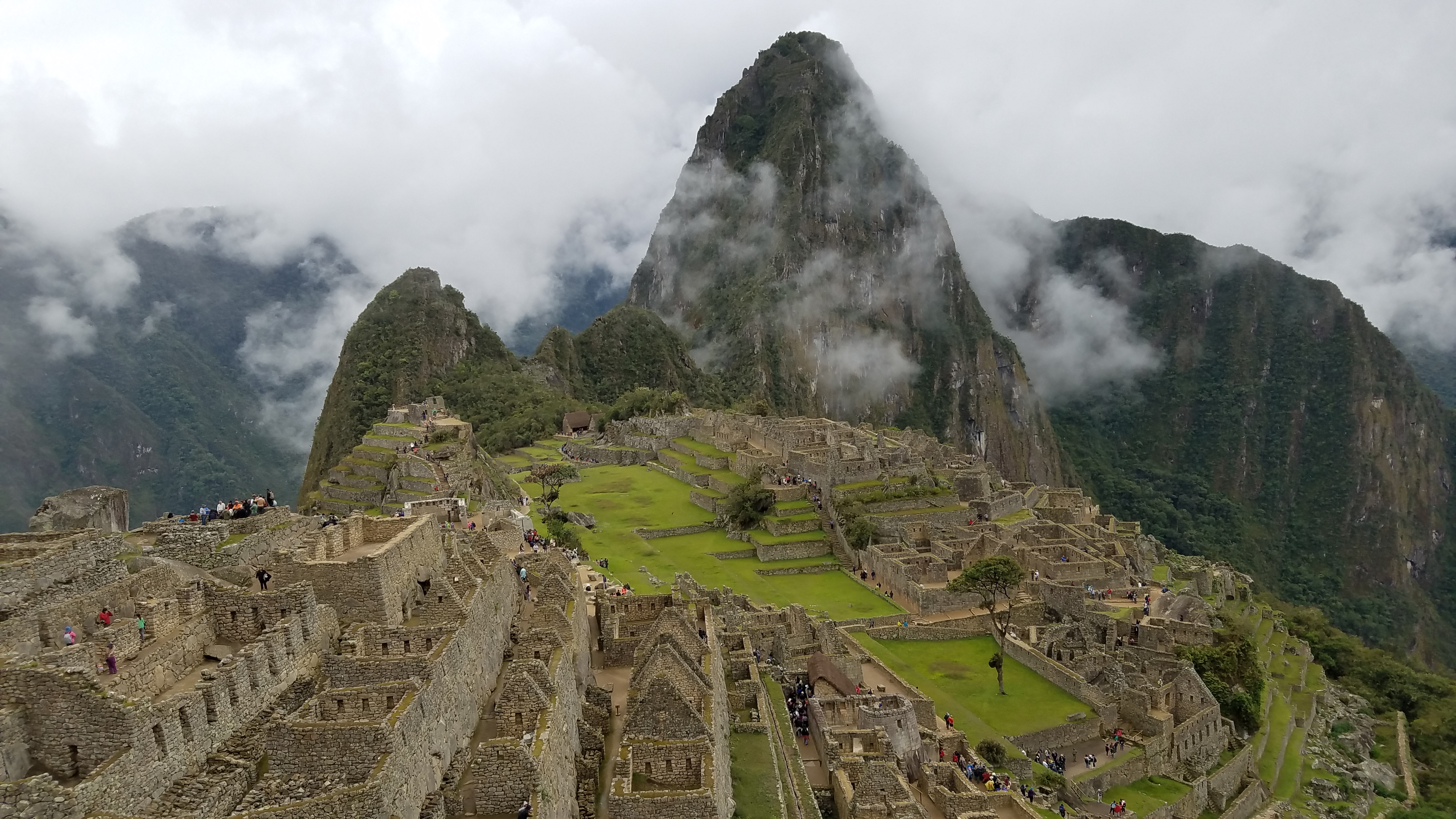
Here it is, the main reason people come to Peru, Machu Picchu. Following the Lares Trek, we went back to Ollantaytambo to board the train to Aguas Calientes. We ALMOST had to change our 1.5 hour train ride to a 4.5 hr bus ride followed by a 10km hike to get there because there was a strike going on. Luckily for us, once we got to Ollantaytambo, we found out that our train would be departing on time, only the 2nd train to leave in the last 3 days (YAAYYY!!).
Once we arrived in Aguas Calientes, we found out that our hotel was not available any more (3 days of no trains means 500 tourists a day finishing the Inca Trail and not being able to leave). We luckily were able to get into another, less quality hotel, Kantu Inn, though. We were put into a first floor room (even though it was 201), which is adjacent to the lobby, has a lobby toilet next to it with ventilation windows from our toilet, to the public toilet, to the toilet in the room across the hall. There was a large window from the room into the lobby hallway with very thin curtains. Every time someone walked by in the hallway, it sounded like they were in the room and the light came on and lit up the room. I did not enjoy this hotel and don’t recommend staying here, if you have a choice.
The next morning, we were up early to be at the shuttle station for Machu Picchu at 6am. There was already a long line that we waited in for an hour and the line was much longer by that point. Get your tickets for the bus ahead of time and get there early. I hear people line up as early as 4 AM to be in the first groups to get in. The gates at Machu Picchu open at 6:00 AM for the public, and 5:30 AM for the people coming in through the Sun Gate from the Inca Trail. The site only allows 2,500 people per day, which includes the 500 per day finishing the Inca Trail, and is closed during the month of February for annual maintenance.
The ruins are quite amazing, considering the 2 hills on which they were built. Seeing them is another story. Most days are cloudy up there, but the weather can change in an instant. It was cloudy and misting for the 2 hour tour, the Inca Bridge, and the Sun Gate, but as I was walking down from the Sun Gate to catch my bus back down, the clouds gave way for a few minutes allowing me to get pictures of the entire main complex and a good amount of the 2nd hill.
There are a few different areas to visit once inside:
– The main complex: This section is the one most photographed and includes the main temples and the most buildings.
– The Sun Gate: This gate is the end of the Inca Trail as it enters the city and is about a 45 minute, uphill walk with quite a few stairs and steep sections, but constant up hill. When I got there, it was in a cloud and there was no view.
– The Inca Bridge: A 20 minute walk from the main complex, you’ll find yourself at a massive cliff. At the bottom of a set of stairs, you can look through a locked gate (for safety) and see some logs placed across 2 rock cutouts in the cliff. Nothing below it but thousands of feet of air, and same above. This bridge could be removed if anyone tried to invade from the other side and there would be no way to get into the city from that end.
For photos from Machu Picchu, check out my album on Facebook.
Rainbow Mountain, Cuzco
While Rainbow Mountain was an excursion out of Cuzco, I felt it deserved its own section. Rainbow Mountain (Vinicunca Mountain) has only been known since about the middle of 2015 as (we were told) it was covered in ice that has since receded leaving the mountain exposed. The mountain is located along a normal 5-6 day hike called the Ausangate Trek.
Now that the mountain has become such a tourist attraction, day trips out of Cuzco can be made to the site, saving you the 5-6 days of hiking. Pickup at the hotel was 3:30 AM, followed by a 2.5-3 hour drive to the start of the hike for us. Since we had just hiked for days to see Machu Picchu, I opted to rent a horse for this hike. Due to the altitude and steepness of some areas, I had to hike the steep areas myself and could ride the horse the rest of the time. We had a nice breakfast at a farm before starting our hike.
The trek is a beautiful 15 km (9.3 mi) that culminates at the Rainbow Mountain viewing hill (right next to Rainbow Mountain) at an astonishing 5,250m (17,225 ft) above sea level. The altitude makes the hike much tougher than it looks as there is a lot of gentle uphill (almost flat), mixed with periods of steep walks. The pain, exhaustion, and lack of sleep is beyond worth it. I arrived at the top about 15 minutes before a large amount of tourists started arriving, so was able to get some great pictures with no one in the way.
The trip was USD $55.00 per person for the hike or USD $100.00 for the hike with a horse. A steal for the transportation, food, and the chance to see this mountain. Don’t skip this tour if you get the chance to do it.
For photos from Rainbow Mountain, check out my album on Facebook.
Puno / Lake Titicaca, Puno
The journey to Puno almost didn’t happen, due to a strike in Puno. We were supposed to take an overnight bus to Puno, but the strike was going to close the road at midnight, so we had to take an earlier bus to be past the checkpoint by midnight. We headed to the bus station in Cuzco, Terminal Terrestre Cusco, to catch our bus to Puno aboard Transportes Transzela. This bus, like the others, was comfortable for the 7.5 hour ride from Cuzco to Puno.
Once we arrived in Puno, we weren’t supposed to have a hotel for the night, as we were to arrive in the morning and check in for the next night. Our guide was able to talk to the hotel company (Casona Plaza Hoteles) we were going to stay (Balsa Inn Puno) and they were able to get us in to their next level up hotel (Casona Plaza Hotel Puno) for the night before checking in to our scheduled hotel the next morning. Both hotels were quite comfortable, centrally located, quiet, had free WiFi, nice beds, and hot showers. Balsa Inn had a breakfast that we were able to take advantage of, but we were not able to have breakfast at the Casona Plaza Hotel because they gave us a room for just a few hours to help us out.
A few of the places I visited for food and drinks were:
Positive Rock ‘N Reggae Bar: I positively loved this bar. It small, dark, and feels like you’re sitting in a cave or dungeon, but it’s quite comfortable. The music is a reasonable volume, the drinks are strong and great price for happy hour (2 for 1)m and they serve appetizers and personal pizzas. A few nights were spent enjoying happy hour in here.
Pacha Mixology Molecular Bar: Upstairs is the bar, downstairs is the pizza/cafeteria. We spent our time upstairs having interesting cocktails, playing pool, listening to music, and overall getting drunk. The most interesting cocktail I got here was a cocktail called Aguaymanto Fizz Esferificado, a cocktail presented in gelatin spheres and made of gin, syrup, lemon juice, and aguaymanto juice (native fruit of bittersweet taste and sour taste to the palate). They look like the picture below, except I had ones with Vodka instead of Gin. In addition to the Gin ones, they also make a Mojito version and Ojos de Diablo (Devil Eyes) that look/sound like they may be spicy.

Dominos Megadisco: Well, as you can probably tell from the name, this is a club. I’m not big on clubs and thought the music was far too loud. It was almost impossible to talk to anyone unless you were yelling in their ear. To me, that’s not necessary to have a successful club (look at silent clubs), especially when there is almost no one in there. Luckily, bottles of Smirnoff vodka and a 2 liter bottle of Sprite were reasonably priced, especially when splitting between 9 people. As the night went on, more people started to show up, but it was still less than half full. I would have rather stayed at Positive or Pacha.
Valeria: This is a small restaurant on the main pedestrian street Lima that had an excellent menu. The food and wine choices were better than a lot of other places and the meal was very flavorful. I had the Filet de Alpaca and would definitely get it again and again. The meat was cooked perfectly, the fries/chips were crisp, the vegetables were steamed with just a slight crispness left to them. Great meal. I recommend this restaurant if in the area. The prices were a little higher than we’ve been seeing, but the quality was also higher.
Ricos-Pan: Not only is this a bakery of fresh breads, cakes, and other pastries, but they also serve great breakfasts, empanadas, juices, and more. This place is worth a stop for anything they have. Our group had everything from bread to the richest chocolate cake possible during our breakfast and there was not a single complaint among 15 people.
Balcones de Puno: The purpose of going here was to see a traditional Peruvian dance show while having dinner. Tickets needed to be purchased to see the show and have dinner, which was not included in the ticket price. So we are paying to see the show. The performers were up there for about an hour doing a wide variety of traditional dances in full costume and the show was pretty good. The food was pricey considering what we had at Valeria and the price we paid there. The biggest downfall was that the dancers came around to each table with a hat to collect tips for their performance. This really bothers me when we bought a ticket to see the show, then had to buy dinner at an inflated rate compared to other restaurants in the area, and then the performers ask for tips on top of it. If you’re really interested in seeing the traditional dances performed, please visit Balcones de Puno. If not, I would just avoid it all together as there are other options in the area.
We also took a boat tour of Lake Titicaca, the highest navigable lake in the world, and stopped at a floating island to see how the local family makes the island, builds their houses, and how they live on these islands in the lake. They dressed us up in traditional attire and showed us how they live. Lunch was had at this restaurant high up on the hill overlooking the lake with great views of the lake since the weather was sunny and mostly clear.
After the boat tour, we went to do a homestay with a local family who lives traditional farming lives on the edge of the lake. They also speak Quechua, not Spanish. So communication was not the easiest. We lucked out that our host spoke some Spanish, but no English at all. I could have done without this part of the tour, but the whole group was going. Once in the village, we (the guys) got to play futbol (soccer) against the local teens. Now, normally this wouldn’t be too bad, but these kids are half our age, or less, and we were at 3,812 m (12,507 ft) above sea level. Needless to say us American, Canadian, and British guys were NOT ready for this kind of workout. A few runs up and down the court (they play on a full size basketball court) and we knew we were in trouble. We kept it close by tying the score at 2 all, but then the kids outlasted us and won 5-2 after what was the longest half hour of running ever. The girls sat on the sidelines and cheered us on as we were dying for breath. Thanks, girls! After the game, the local families dressed us up in traditional clothing and then taught us a traditional dance that we butchered, but they were happy we tried. Next stop was to the houses for dinner and sleeping. I put out my GoPro to catch the stars as it was super dark out, clear, and we’re at such a high altitude. Check out the video here.
Waking up early the next morning for breakfast and our ‘chores’ as a Thank You to our hosts, we had no idea what was about to come. We started easy by doing the breakfast dishes, bringing the pigs out to eat the leftover food from last night and this morning, took the sheep all the way out to the lake edge to feed, tied them up while pulling reeds from the stalks to feed the sheep, then went all the way back to get the pigs and bring them out to the same area we brought the sheep, had to dig an area with a pick-ax for to turn up roots for the pigs to eat, and last, but not least, we got to plow a field with a pick-ax. We thought we were just doing an area about 10 m (32 ft long) by 1 m (3 ft) wide and we were wrong. We ended up doing a field that was about 20 m (65 ft) by 10 m (32 ft) wide with 2 pick-axes for the 3 of us, and one was falling apart. The ‘approximately 45 minutes’ of chores took a little over 2.5 hours before they let us leave. They definitely got their money’s worth out of us. Parched and sore, we headed back to the boat to head back to Puno.
For photos from Puno / Lake Titicaca, check out my album on Facebook.
La Paz, La Paz, Bolivia
We crossed the border into Bolivia and continued our way to La Paz. For this part of the trip, please visit my Bolivia page.
I hope this gives you some inspiration to take a trip to Peru. It truly is amazing and you will love it. For photos from the trip, check out my albums on Facebook.
Please share with your friends using the links below. If you have any questions or comments, please reply using the box below.
Thanks for reading!
 Over The Horizon, LLC