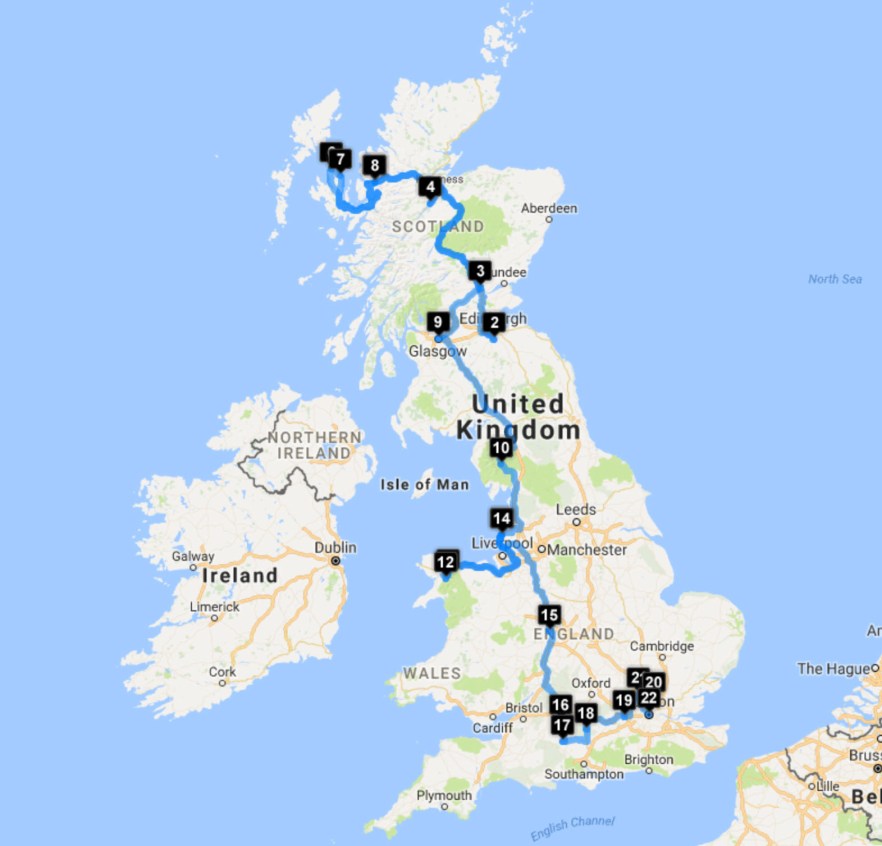
Length: 19 days (6 days in Scotland, 2 in Wales, 11 in England)
Tour Company: Over the Horizon
Tour: UK Self Guided
Traveler: Dave
Places visited:
1 – Edinburgh, UK
2 – Rosslyn Chapel, UK
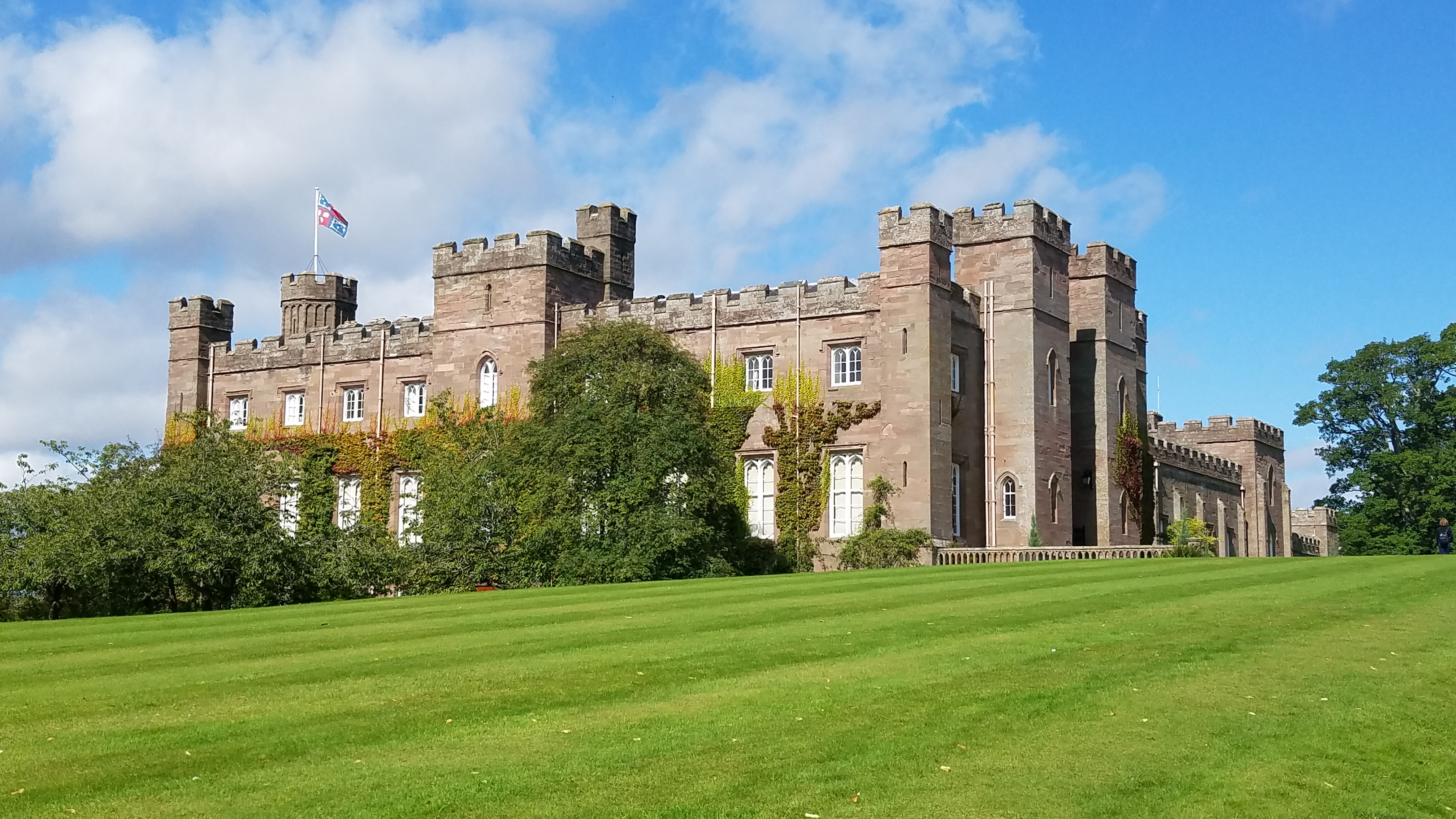
3 – Scone Palace, UK
4 – Loch Ness, UK
5 – Torridon, UK
6 – Duntulm Castle, UK
7 – Kilt Rock and Mealt Falls Viewpoint, UK
8 – Torridon, UK
9 – Glasgow, UK
10 – Lake District National Park, UK (See UK – England – August 2017)
11 – Southport, UK (See UK – England – August 2017)
12 – Dinorwig, UK (See UK – Wales – August 2017)
13 – Zip World Penrhyn Quarry, UK (See UK – Wales – August 2017)
14 – Southport, UK (See UK – England – August 2017)
15 – Dudley, UK (See UK – England – August 2017)
16 – Avebury, UK (See UK – England – August 2017)
17 – Stonehenge, UK (See UK – England – August 2017)
18 – Highclere Castle, UK (See UK – England – August 2017)
19 – Windsor, UK (See UK – England – August 2017)
20 – Cheshunt, UK (See UK – England – August 2017)
21 – St. Albans, UK (See UK – England – August 2017)
22 – London, UK (See UK – England – August 2017)
I flew with Ryanair from Dublin International Airport to Edinburgh Airport in Scotland to start the rest of my UK tour. Flying from Ireland to Scotland was less than an hour and had no customs check upon arrival.
I was apprehensive about booking with Ryanair because of their reputation of being “cheap”, but found their service to be quite good. The price was great, but I didn’t feel that anything was really missing from the flight. The seats were slightly smaller, less comfortable, and had less leg room than the major airlines, but were no problem and comparable to any of the other “low-cost” airlines I’ve taken.
Check-in at Dublin International was easy, security was quick, but waiting for a gate assignment was a bit of a pain. They did not assign a gate until 30 minutes before the flight, so knowing where to go after security was a guessing game until it posted. On arrival in Edinburgh, deplaning was quick, baggage did not take long to arrive, and getting the rental car was quick, once I made it to the car rental lot, which was a long walk from where I exited the terminal, but thankfully it wasn’t raining.
I again rented a car through Avis since I was doing a road trip of Scotland, England, and Wales. This time I had no issues with the selected insurances, unlike Ireland. The car I got was a Fiat Tipo Hatchback which is a compact SUV, 1.4L Petrol, 6 Speed, 95 hp (70 kW), and had plenty of storage space, but was not nearly as nice as the Peugeot 2008 I had in Ireland.
I used Booking.com for all my overnight stays in Scotland.
Since I’ve been to Edinburgh in the past (way back in 1998), I decided to skip it on this trip and check out some other places. First up for me was a 20 minute ride to Rosslyn Chapel.
Rosslyn Chapel
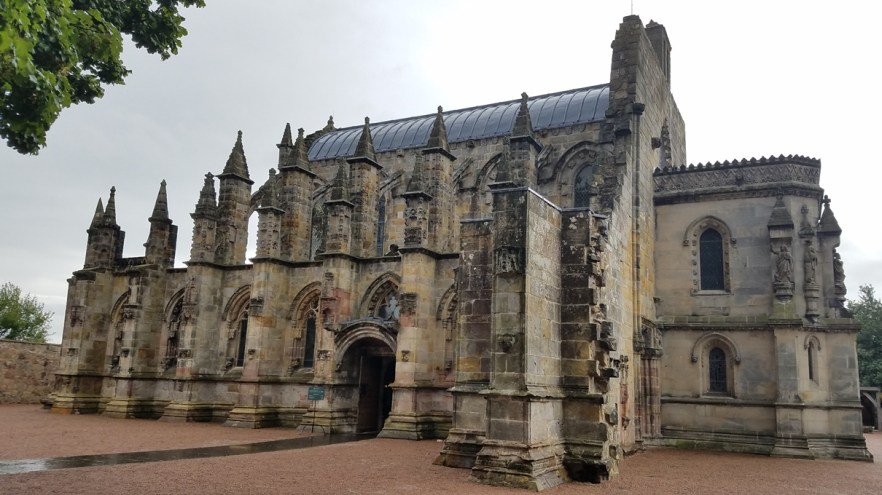
Rosslyn Chapel is located in Midlothian, which is just South of Edinburgh. Officially, the Chapel is known as the Collegiate Church of St. Matthew and is an active Scottish Episcopal Church. Construction of the chapel by William Sinclair began on September 20, 1456, although it has often been recorded as 1446. The confusion over the building date comes from the chapel receiving its founding charter to build a collegiate chapel in 1446 from Rome. Sinclair did not start to build the chapel until he had built houses for his craftsmen.
For it’s time, the late Middle Ages and the beginning of the Renaissance era, Rosslyn Chapel was ambitious and extraordinary in terms of the design details. Sinclair’s progress was slow because attention to detail and striving for perfection took precedence over speed. This left the Chapel with only the east walls, the walls for the choir, and the foundations for the nave finished by the time of his death in 1484. Sir William was buried beneath the unfinished choir, which was completed and roofed shortly afterwards by his son, and then building ceased. The Chapel remained as a family place of worship for the Sinclair’s through most of the 1500’s.
It is the intricate carvings, and the mysteries and symbolism behind them, that fascinate people about Rosslyn Chapel. Symbols within Rosslyn Chapel portray a range of subjects from Biblical stories to Pagan symbolism. There are carvings of plants such as Indian Corn which were unknown in Europe at the time of their construction. This can be explained by the popular story of Sir William’s Grandfather, Henry Sinclair, that he was part of an expedition to Nova Scotia in 1398, returning and bringing with him botanic knowledge from other continents.
Since the late 1980s, the chapel has also featured in speculative theories concerning a connection of Freemasonry, the Knights Templar and the Holy Grail. It was prominently featured in the 2003 bestselling novel ‘The Da Vinci Code’ and its 2006 film adaptation.
Entry to the site was £9.00 ($11.70) and is self-guided. The chapel can be very busy, especially inside. There are no pictures or video allowed to be taken inside the chapel, but there are no restrictions outside the chapel.
For more pictures, check out my album on Facebook.
After Rosslyn Chapel, I drove about an hour North to Perth where I planned to stay the night at the Sky Lodge before checking out Scone Palace the next morning. Located at the Perth Airport, about 10 minutes NE of Perth, Sky Lodge provides guests with private accommodation at budget prices. With room prices starting from just £23.95 ($31.14) per room, per night. There are 40 en-suite rooms, consisting of 23, 3-Star double and twin rooms, including inter-connecting rooms, and 17 basic compact single ungraded rooms. The property includes 24 hour manned security, free car parking, and available continental breakfast.
The room I had was an adjoining room and the people in the next room may have been in my room. The walls and adjoining door offer no noise reduction and I had a particularly noisy group next to me. The bed was comfortable, there was a TV, a desk, and the en-suite bathroom was small, but not an issue. For the prices in the area, the Sky Lodge was my best option, but if you’re interested in more comfort and quiet, this is not the place for you.
Scone Palace
Scone Palace was the crowning place of Scottish kings where Macbeth, Robert the Bruce, and Charles II were once crowned. Scone breathes history like nowhere else in Scotland. It is the family home of the Earls of Mansfield and the ancient crowning place of Scottish kings on the Stone of Scone. See where the Stone of Scone, known as the Stone of Destiny, once stood (it now resides in Edinburgh Castle).
Loch Ness
Here Nessie, Nessie, Nessie… Where are you?? A 2.5 hour drive from Scone Palace brought me to the famous Loch Ness. Loch Ness is a large, deep, freshwater loch (lake) in the Scottish Highlands, extending for approximately 23 mi (37 km) southwest of Inverness. It is one of a series of interconnected, murky bodies of water in Scotland. Its water visibility is exceptionally low due to a high peat content in the surrounding soil. Loch Ness is the second largest Scottish loch by surface area at 22 sq. mi (56 sq km) after Loch Lomond, but due to its great depth, it is the largest by volume in the British Isles. Its deepest point is 755 ft (230 m / 126 fa) making it the second deepest loch in Scotland after Loch Morar. It contains more fresh water than all the lakes in England and Wales combined, and is the largest body of water in the Great Glen, which runs from Inverness in the north to Fort William in the south.
Loch Ness is best known for alleged sightings of the Loch Ness Monster, also known affectionately as “Nessie”. It is similar to other supposed lake monsters in Scotland and elsewhere, though its description varies from one account to the next. Popular interest and belief in the animal’s existence has varied since it was first brought to the world’s attention in 1933.
While I did not find Nessie, I did find some of that “good Scottish weather” that Mel Gibson mentions as William Wallace in Braveheart… “the rain is falling straight down, well, slightly to the side like”.
For more pictures, check out my album on Facebook.
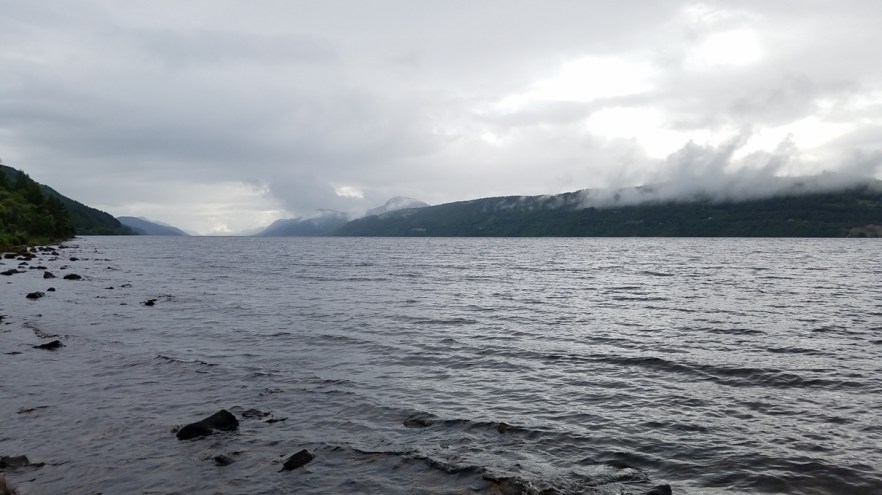
Loch Ness
Torridon
After getting rained out at Loch Ness, I drove another 2 hours West through the beautiful Scottish Highlands to where I was staying for the next 3 nights, the Torridon Youth Hostel. Torridon Youth Hostel is part of the SYHA (Scottish Youth Hostel Association) and part of Hostelling International. I had a bed in an 8 bed male dorm for £25 ($32.50) per night. While this may not sound like a great deal for a bed in an 8 person dorm, keep in mind that it was in the height of summer travel season, in the Scottish Highlands, close to Isle of Skye, and last-minute. This was the only accommodation available within 150 miles of Skye (this was actually 45.6 mi / 73.4 km by road to the Skye Bridge).
Torridon Youth Hostel (although I was the most youthful person there) is a great option for all those with an adventurous spirit, wishing to experience the real Scotland. The hostel is purpose-built and offers modern, practical facilities for outdoor enthusiasts and visiting groups looking for good quality affordable accommodation. There’s a spacious self-catering kitchen, two large panoramic lounges, a drying room (your gear will get wet in the Highlands), free WiFi in the common areas (spotty coverage at best), free on-site parking, a quiet room (which has the best WiFi reception outside the main lobby), and a range of private and family rooms, as well as shared accommodation. With dog friendly accommodation available at Torridon Youth Hostel, your four-legged friend will be able to join in on all the fun! A small fee of five pounds per dog per night will be charged and must be booked in advance to ensure that a dog friendly room is allocated.
Whether you’re scaling the heights, biking the trails, walking the coastal paths, discovering the local wildlife, or sampling the fine local seafood while taking in the stunning scenery, there is something for everyone. The Torridon area is a magnificent corner of the North West Highlands, boasting some of the finest mountain scenery in Europe. Walkers are spoiled for choice with numerous hills, coastal trails, historic passes, and hidden glens to explore. For the best advice ask the staff who will be happy to share their local knowledge with you.
For more pictures, check out my album on Facebook.
Isle of Skye
The Isle of Skye is a truly magical place. The largest of the Inner Hebrides (an archipelago comprising hundreds of islands off the northwest coast of Scotland), it’s home to some of Scotland’s most iconic landscapes. The island has countless ways to enchant you, with its mountain ranges, miles of dramatic coastline and captivating history. If there’s one thing about Skye that’ll leave a lasting impression on you, it’s the scenery. Just driving around, you can see many of Skye’s most majestic geological features, such as the Old Man of Storr, the Quiraing and the Cuillin. Be sure to take your best pair of hiking boots and explore these unique sights on foot for the real rewards. The island also has a wealth of history, from prehistoric sites to brooding castles.
I drove the main loop of A87 into A855, which took my up the East coast of Skye and around the Northern Trotternish Peninsula, which has the highest peaks on the island.
For more pictures, check out my album on Facebook.
The A855, at north end of the Trotternish Peninsula, emerges on its west coast at the small settlement of Duntulm. Beyond the settlement, a rocky promontory (a point of high land that juts out into a large body of water) is the location of the ruins of Duntulm Castle, offering a superb defensive location guarded on three sides by sheer cliffs.
A well made path leads along the coast to Duntulm Castle from a bend in the main road a few hundred yards to its South East. A sign on the gate at the start of the path notes that the castle is structurally unstable and that “for your safety you are advised not to proceed beyond the castle fence line”. A further sign at the castle end of the path reinforces the message. Should you choose to explore the castle despite these warnings, do so with great care. There are cliffs surrounding the ruin and part of the structure have collapsed into the sea in the relatively recent past.
Duntulm is believed to have been first fortified in the Iron Age, and the site continues to be associated with the name Dùn Dhaibhidh or “David’s Fort”. Later in life it was fortified by the Norse, and subsequently by their successors, the MacLeods of Skye. By the early 1600s, Trotternish was under the control of the MacLeod’s rivals on Skye, the MacDonalds of Sleat. The MacDonalds abandoned the castle in about 1730 in favor of nearby Monkstadt House and then Armadale Castle in Sleat. Some say this was after a nursemaid accidentally dropped the baby son of the clan chief from a castle window above the cliffs. The ghost of the nursemaid, killed in retribution, is still said to wander the ruins. She is apparently kept company by the ghost of Hugh MacDonald, who plotted against the rightful clan chief in the 1600s, and who was starved to death in the dungeon at Duntulm.
For more pictures, check out my album on Facebook.

Isle of Skye – Duntulm Castle
Although the majority of Skye is composed of fossil-free basalt rock, there are exposures of sedimentary beds in several places around the coasts. Many of these exposures are difficult to reach and many of these are rich in fossils. For the casual fossil seeker, the most attractive of Skye’s sites are the ones with evidence of dinosaurs and, luckily, two of the best places to find them, Staffin and Duntulm, are very easy to get to.
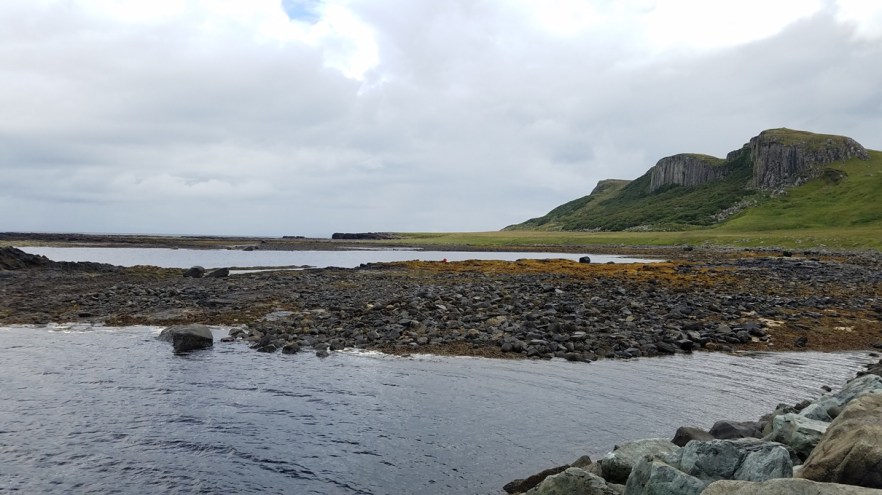
An Corran Beach is located in Staffin on the North East side of the Trotternish Peninsula, about 8.5 mi (13.7 km) from Duntulm Castle. On the beach at An Corran are some dinosaur footprints. They were left by a family of dinosaurs that walked across the sand here approximately 165 million years ago. The dinosaurs that passed here were Ornithopods, herbivorous creatures who walked on two legs. They, along with the carnivorous Megalosaurus and the omnivorous Cetiosaurus and Stegosaurus, contribute to Skye’s reputation as the “Dinosaur Isle”.
There is a cluster of footprints on a bed of sandstone on the beach, but the prints are covered by the sea at high tide, and are often covered by sand in the summer. The best time to see them is after a winter storm, when the sea has swept the sand away, but it’s worth a look at any time. You may be lucky. The main prints are not too far from the ramp that runs down to the beach at Staffin.
I was not fortunate enough to see the footprints on the day I visited. I would love to go back and spend more time exploring Skye and all it has to offer.
For more pictures, check out my album on Facebook.
Isle of Skye – An Corran Beach
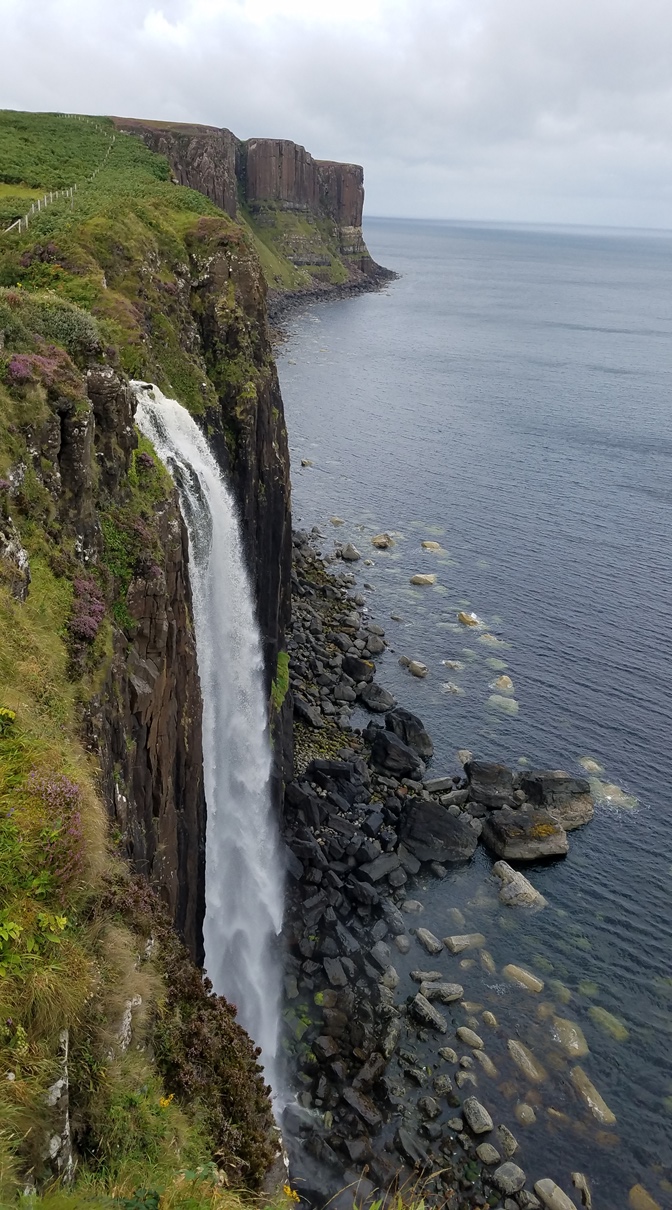
Just 3 mi (4.8 km) further South from An Corran Beach is Kilt Rock and Mealt Falls Viewpoint.
The famous Kilt Rock is a sea cliff that is said to resemble a kilt, with vertical basalt columns to form the pleats and intruded sills of dolerite forming the pattern. This is a popular stopping point on the road between Portree and Staffin and there is a large car park by the waterfall. You have to look north up the coast to see the Kilt Rock. Closer by is the Mealt Waterfall, which freefalls off the cliff for 197 ft (60 m) into the Sound of Raasay below. Sometimes, when the wind is strong, the water is blown away and it doesn’t reach the bottom at all.
For more pictures, check out my album on Facebook.
Isle of Skye – Kilt Rock and Mealt Falls
Glasgow
I checked out of the Torridon Youth Hostel and made the 4 hour and 15 minute, 228 mi (367 km) drive to Smiths Hotel in Glasgow. Smiths Hotel is located in Glasgow’s West End, just under 1 miles from the heart of the city. This Victorian town house is now a family-run hotel offering budget accommodations. There is a range of accommodations to suit the needs and budget of any traveler. Most rooms have private bathrooms and rooms with shared bathrooms are also available. Free WiFi is available in all rooms. I had a single room with en-suite bathroom, which was very small. You could see how the larger rooms of the original town house were divided into smaller accommodations by looking at the ceiling and seeing how the wall cut into the original design elements. Free parking is available behind the hotel, but is limited. Make sure to tell them ahead of time if you need parking.
Glasgow is the biggest city in Scotland, with a population of about 600,000 in the city itself, or over 2 million if the metropolitan area are taken into account. Located at the West end of Scotland’s Central Belt on the banks of the River Clyde, Glasgow’s historical importance as Scotland’s main industrial center has been challenged by decades of change and various regeneration efforts. The third largest city in the entire United Kingdom (by population), it remains one of the nation’s key economic centers outside London.
The city has transformed itself from being the once mighty powerhouse of industrial Britain to a center for commerce, tourism, and culture. Glasgow was the host city for the Commonwealth Games in 2014 and has become one of the most visited cities in the British Isles. Visitors will find a revitalized city center, the best shopping outside London, excellent parks and museums (most of which are free), and easy access to the Highlands and Islands.
After a night at the hotel, I packed up the car, checked out, and drove to the Duke Street Car Park which is located near some of the more popular attractions in the city.
The first place I visited was the Glasgow Necropolis. The Glasgow Necropolis is a Victorian cemetery located on a low, but very prominent hill to the East of Glasgow Cathedral (St. Mungo’s Cathedral). Fifty-thousand individuals have been buried here and, as was common for the period, only a small percentage are named on monuments and not every grave has a stone. There are approximately 3500 monuments on the property.
For more pictures, check out my album on Facebook.
Right next to the Necropolis is Glasgow Cathedral (St. Mungo’s Cathedral). The first stone built Glasgow Cathedral was dedicated in the presence of King David I in 1136, but the present building was consecrated in 1197. Since that same period, the Cathedral has always been complete and the worship of God has been carried out within its walls for more than 800 years. The achievements of the architects and builders of those times is to be admired. The Cathedral also has one of the finest post-war collections of stained glass windows to be found in Britain.
This is the best preserved example of a large church to have survived from the medieval period in Scotland and no visitor should leave the city without making a visit.
For more pictures, check out my album on Facebook.
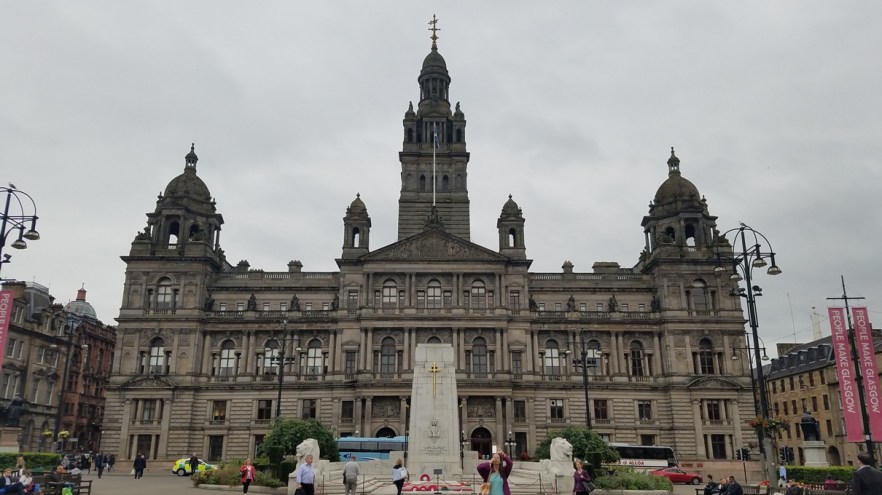
I decided to walk around the city for a little while and ended up at George Square. George Square is the principal civic square in Glasgow and is named after King George III. Laid out in 1781, George Square is surrounded by architecturally important buildings including the palatial Municipal Chamberson, also known as the City Chambers, which is the continuing headquarters of Glasgow City Council. The square boasts an important collection of statues and monuments, including those dedicated to Robert Burns, James Watt, Sir Robert Peel and Sir Walter Scott.
For more pictures, check out my album on Facebook.
George Square
The journey continues into England and Wales, which you can read about here:
UK – England – August 2017
UK – Wales – August 2017
I hope this gives you some inspiration to take a trip to Scotland. For photos from the entire trip, check out all my albums on Facebook and my YouTube channel.
Please share with your friends using the links below. If you have any questions or comments, please reply using the box below.
Thanks for reading!
 Over The Horizon, LLC